Mathematics in Biology
by Markus Meister, Kyu Hyun Lee, and Ruben Portugues
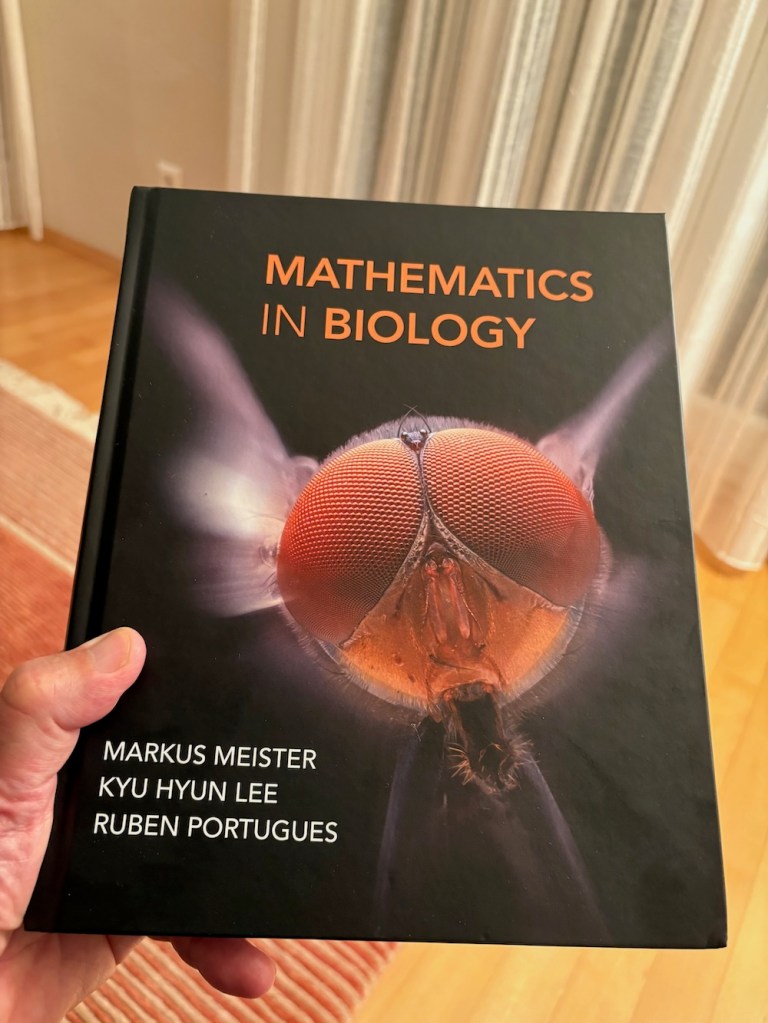
Biology has rapidly become a quantitative science, with mathematical methods infusing all aspects of the scientific process: from the design of instruments for observation, to processing the resulting data, to inference and modeling for the extraction of knowledge. Unfortunately higher education in Biology has not quite kept up with these developments.
Most undergraduate programs include no mathematical training beyond calculus. Often times, Biology is still advertised as a route to a science career that avoids exposure to higher math. As a result, a typical Biology graduate is not prepared to follow many high-profile articles in Biology journals that use advanced mathematical methods. Even appreciating the basic phenomena of Biology often requires some mathematical sophistication. Take, for example, the Nobel-winning discoveries surrounding the mechanism of mutation (Luria-Delbrück), communication between neurons (Hodgkin-Huxley), or circadian rhythms (Hall-Rosbash-Young).
True, certain sub-disciplines in life science have had a tradition of mathematical treatments, for example population biology, or theoretical neuroscience. Typically, this mathematical foundation is limited to a subset of methods, and PhD students choosing those subjects will have to learn the associated special tools. Would it not be preferable for students to be equipped with sufficient mathematical background by the time of their first degree, and before they choose a particular discipline?
To accomplish this, we have been teaching a mathematical methods course to advanced undergraduates and first-year graduate students in the biology departments at Harvard, Caltech, and TU München. After a few years of experience with this, the faculties at Harvard and Caltech made the course a requirement in life science graduate programs. Based on those teaching efforts – and over about twelve years of gestation – we wrote this book, now out at MIT Press. See here for a table of contents, sample chapter, and other materials.
What makes this book “for biologists”? After all, mathematics is the same regardless of application area. We see our special contribution here in three ways:
• The choice of areas. We focus on three subjects that are fundamental to life science: linear systems; probability and statistics; and nonlinear dynamics. Vice versa, we intentionally chose to ignore others, such as group theory, which you would find in a corresponding book for physicists.
• The style of presentation. We treat the mathematics rigorously, but with an emphasis on practical uses, rather than theoretical abstraction and completeness.
• A broad sample of applications drawn from different areas of life science, illustrating how these methods work in practice.
This book can accompany a one-year mathematical methods course, but we have also given shorter courses covering a single semester or 10 weeks, based on appropriate selections of the material. Naturally the book also serves as a guide for self-study. And as a reference work to keep on the shelf after you have completed the course.
We also want to build a community around the book with you, the readers, using the associated web site, for example:
• The web site offers value-added materials, for example sample curricula, and the code for generating every figure in the book.
• The book contains many exercises, but no solutions. We invite student readers to produce such solutions and we will publish the best ones on this site with author credit.
• Readers can suggest further topics or new chapters, especially for the sections on advanced topics and applications. As we develop new material, it will be openly available here.
• We rely on readers to spot the inevitable errata and suggest corrections.
Most of all, we hope that this book project will help Biology students to tackle problems they might otherwise have avoided, and to bring their studies and research to a new level of quantitative richness.
 Bits, Brains, and Behavior